
That’s what I call the narrow garden bed that leads up to the front steps of the house. There are four different penstemons in that bed, although one is actually a Keckiella (Yellow Bush Penstemon, Keckiella antirrhinoides), and two are as yet unidentified. (I have a bad habit of not saving the tags from the nursery, assuming that I’ll remember what I’ve planted. Ha!)
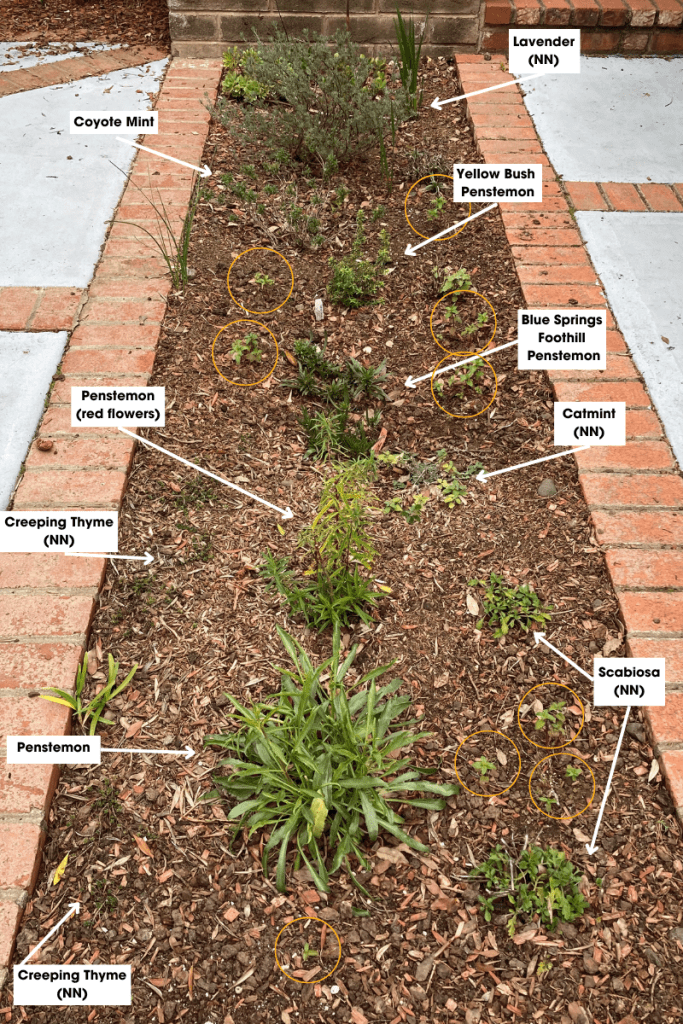
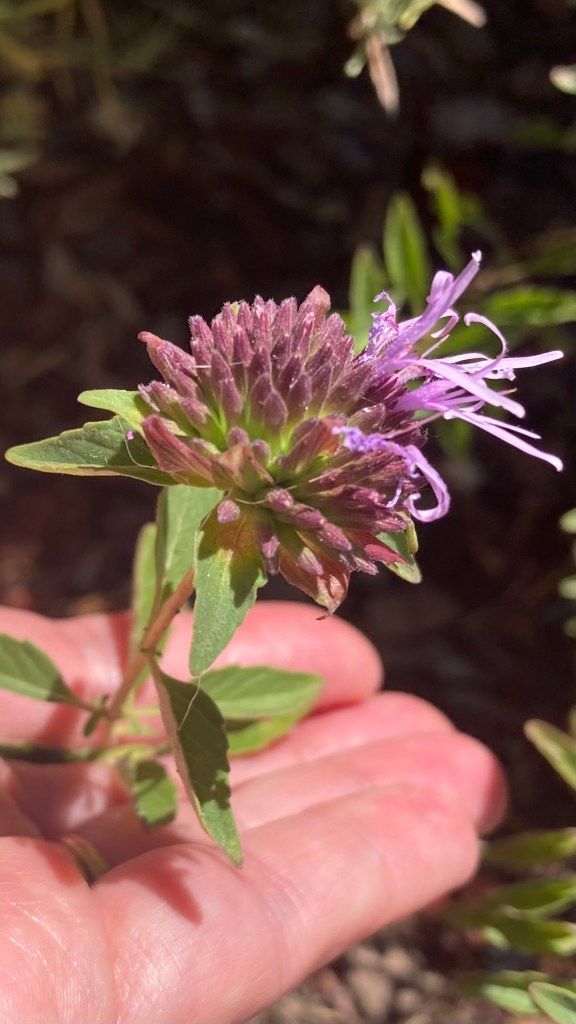
I’ve also got a Coyote Mint (Monardella villosa) growing and several clumps of native wildflower seedlings. Those are marked with the orange circles on the photo. It looks like most of the wildflower seedlings that survived transplantation and the onslaught of the White-crowned Sparrows are the Purple Innocence flowers. If those can make it to flowering, I will be SO excited. They are so beautiful! (See my January 18th post for a photo.)
I’m pretty sure everything else in the photo is non-native, including the lavender and the group of plants at the back of the bed. There are a couple of succulents back there, some flower bulbs (freesia, I think?), a carnation plant, and … I’m not sure what else. Those were mostly planted by the previous resident of the house.
Rosebushes out, mostly natives in
When we first moved in, the rest of the bed was occupied by a few small, sickly rosebushes. (That’s a familiar thread throughout the yard.) But I let them be that first summer. I added scabiosa (pincushion flower) and catmint (nepeta), hoping to attract pollinators. And, I put in some creeping thyme to fill in between the roses. (This was before my native plant epiphany.)
After taking native plant classes with Nicholas Hummingbird (find him on Instagram: @california_native_plants), I started taking out the rosebushes and putting penstemon in their place. Except that I didn’t do enough research at first and ended up buying cultivars and penstemon that may not be native to the part of California in which I live. I’m waiting to see how they fare this spring and if I can identify all of them once they are all flowering.
The biggest penstemon at the front of the photo has 4 or 5 flower buds developing now, so those will presumably bloom soon. I’m not sure about the others, though. I think they are all spring or spring/summer bloomers, but I’m not seeing any other buds yet. Of course, it won’t be spring officially for another few weeks. That’s easy to forget when it’s 65 degrees and sunny outside in mid February!


Plans for this bed: More natives!
There’s a lot of open space still in this bed, so I hope to fill in with some more natives, including grasses and wildflowers that bloom at other times of year.
p.s. I had to share the daffodils that bloomed this morning. I didn’t know the bulbs were hiding in one of the front beds, along with some grape hyacinths. Even though they’re not native to the United States, I can still admire their cheerful beauty and lovely scent!


 Putting Down Roots
Leave a comment