
“Native plants take a while to establish.”
That’s something I’ve heard over and over again. But how long is a while? I’m sure there’s no one answer, but I’ve heard everything from a few weeks to 2 or 3 years. I’ve also heard that you need to water native plants regularly until they’re established, but then–at least for California natives–only water them maybe once a month or not at all.
So, how do I know what to do?
I keep reminding myself that the California native environment is on a different timetable. I’m coming at this, first of all, from the mindset of a completely different environment 3,000 miles away. And, I formed that mindset over five decades. So, it’s going to take more time to come out from under it. (I can’t even tell you how WEIRD it is to me to be planting seeds in November and having them sprout! Fall was the time for planting bulbs in New England, but you wouldn’t see them again until spring!)
I know my vision is also clouded by who I am–a white person, descended from foreigners to this land who probably thought of nature as something to battle and conquer. Although I seem to be more aware of plants, animals, and the land than the average person with my heritage, that doesn’t mean I understand the cycles of the seasons, how everything is interconnected, or what native plants need, especially in this place where I’m a newcomer.
But I do love quietly listening and watching nature and learning from it. And, I try as much as possible to learn from Indigenous knowledge that has been developed over thousands of years, by people who understand this land and how they are a part of it.
As I walked around the backyard yesterday, I noticed the mugwort (Artemisia douglasiana). I had originally planted it in those front yard beds I talked about in my last post, where it was very sunny and very dry. I planted it there before I had studied the yard or understood the sunlight’s path upon it. When the mugwort turned silver and its leaves dried up, I worried but gave it more time.
At some point, I re-researched it and realized that mugwort generally grows in riparian areas. It can deal with full sun–if it has consistent moisture. I felt like an idiot, but it was late summer, and I didn’t want to stress the plant out further by moving it. I tried shading it with a big potted plant. I tried to keep it well watered. Still, it was silver, with dry, curled-up leaves. Whenever I came across mugwort at nurseries, the plants were healthy and tall, with pale green leaves. I thought maybe the mugwort I had planted was still getting established and needed another winter of rains.
But after another winter, spring, and summer, the mugwort still hadn’t grown much and never flowered. So, a few weeks ago, once the sky had drizzled a few times and the daytime temperatures were no longer crazy hot, I dug “Muggie” up and moved it to a spot in the backyard. The new spot was shaded most of the day and tended to be moist because it’s right next to the spigot and hose I use back there. It’s also right next to a bird bath that I spray out and refill every morning. When I do that, water goes everywhere. After I shut the water off, I let the hose drip out the remaining water on that area of the yard. I figured that might be similar to the mugwort being near a stream or river.
So far, at least, it seems to have been a good move. The mugwort is green, its leaves are long and straight, and the plant has nearly doubled in size.
Maybe I waited too long to move the mugwort. Maybe it will again struggle in the summertime because there is no natural stream in the yard. But I’m happy that it seems happier now, and I’m glad that I took time to learn and observe before making a drastic change. Every little bit of knowledge I gather helps build my confidence and take another step on this journey.
And, how amazing is it that Muggie survived all that time while it was parched and stressed and then bounced back within days?!? Native plants are so resilient and forgiving!
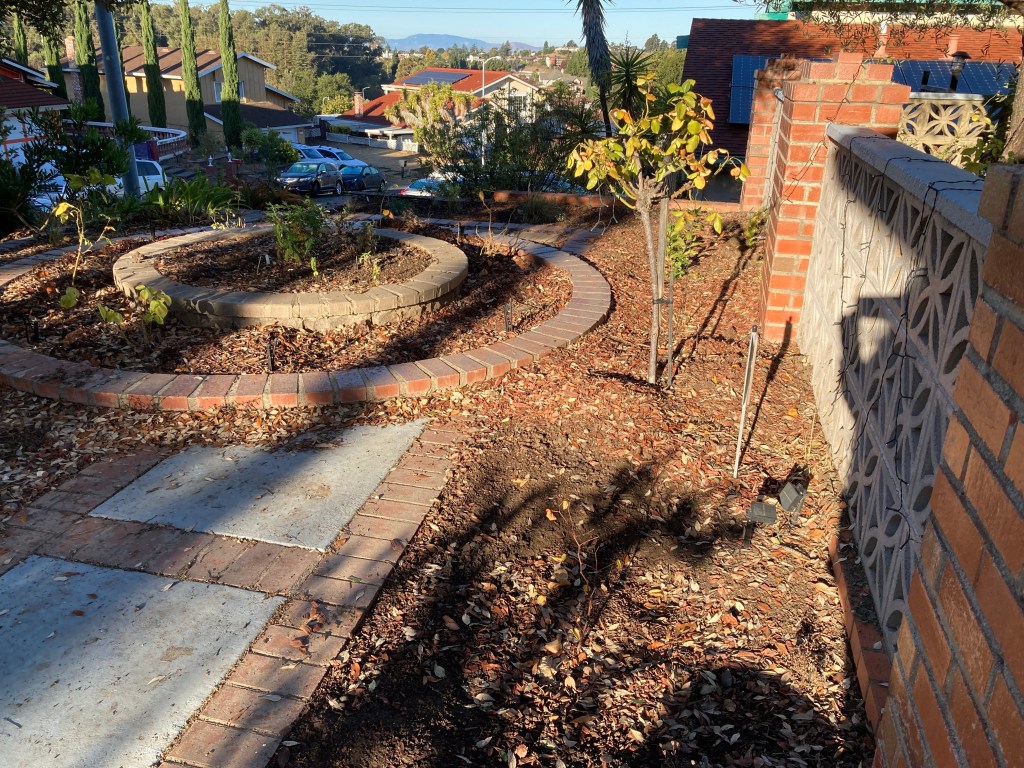
Here’s a sneak peek at the next area of the yard I’ll be sharing. Look at all the brick, dyed wood chips, and painted concrete!


 Putting Down Roots
Leave a reply to lisatheardentgardener Cancel reply